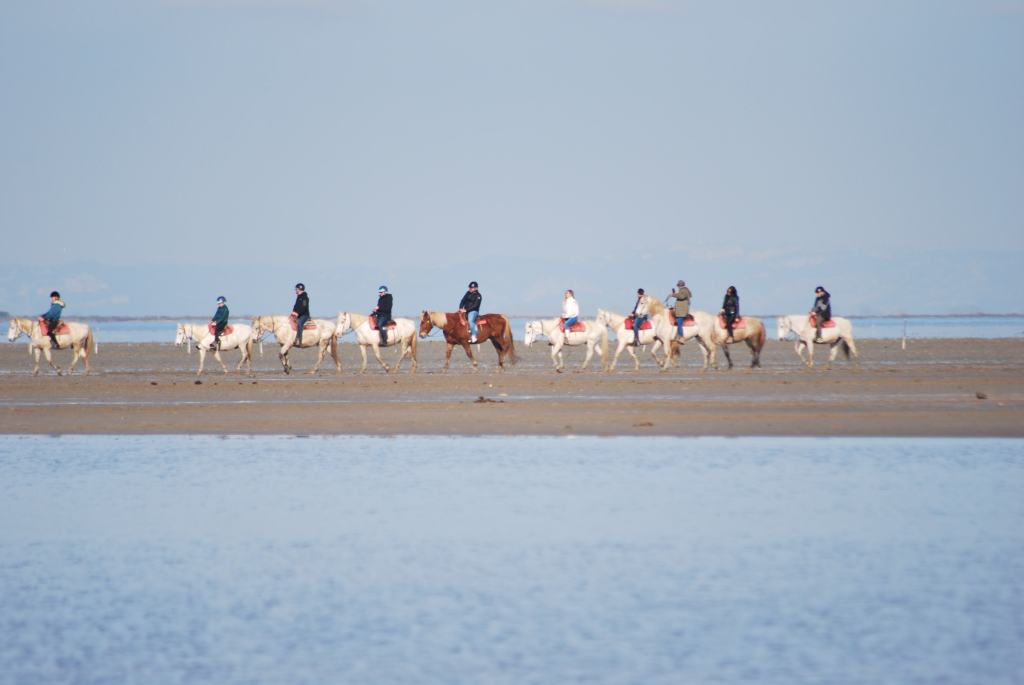
Before we check out Van Gogh’s series of works painted in Saintes-Maries-de-la-Mer, we trundle around the vast marsh and lagoons which border the sea beside Camping La Brise de Camargue. It is big sky country here, the sun breaking through white clouds, strings of riders out on horseback threading through the marsh’s paths.
An egret grubs around in front of me on a path, not at all bothered by my presence. Flamingos bury their heads in lagoon waters.

Red glasswort stretches to the horizon; stunted tamarisk trees lean away from the path of the fierce Mistral winds from the north. Today though there’s no such wind as we follow the sandy paths through this watery world.

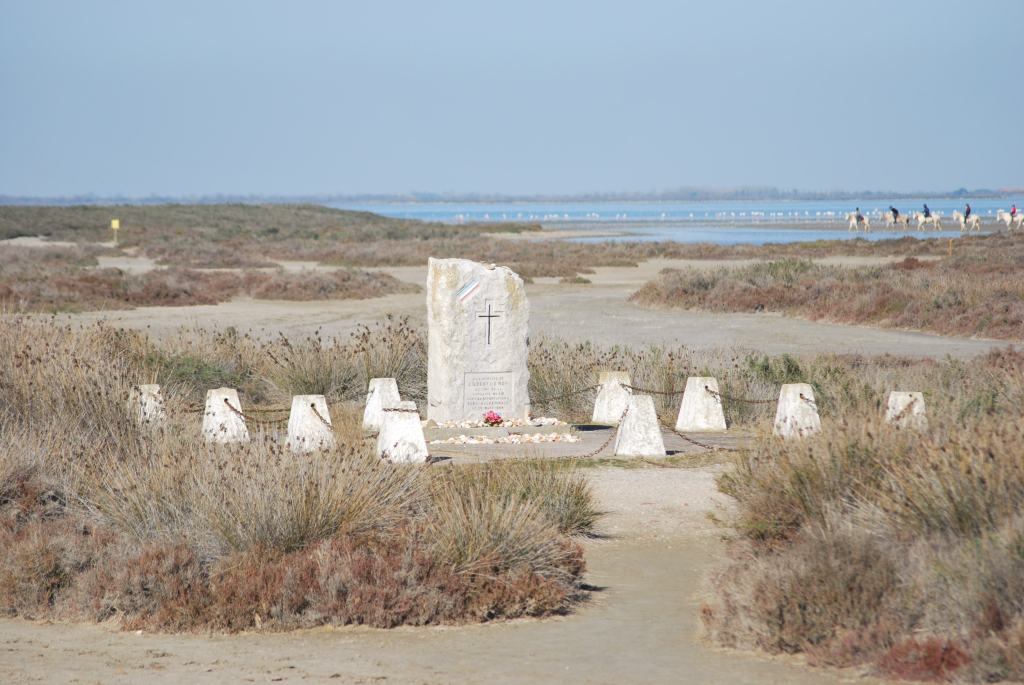
We stumble upon a memorial to Gilbert Leroy, who was deported to Buchenwald by the Nazis in 1944. Many would have felt these marshes are far from the human world, but look closely and you can see the hand of man everywhere, sluices, bridges, intricate engineering projects and, sadly, a memorial to a victim of oppression.
The beaches of Saintes-Maries-de-la-Mer are similarly engineered, with sturdy stone flood defences, a long way from the scene in the reproduction of Van Gogh’s Seascape near Les Saintes-Maries-de-la-Mer (June 1888) on the promenade, which presents the seahorses charging towards the viewer on tumultuous waters. Interestingly, the grains of sand found in the paint layers have traced the painting back to this point in the town.

Van Gogh ran green and yellow through the waves too, to capture the play of light and force of the wind. I’m intrigued by his description of the sea’s colour: it ‘has a colour like mackerel…changing…’ Today, the flood defences could be said to make the water a bald blue.
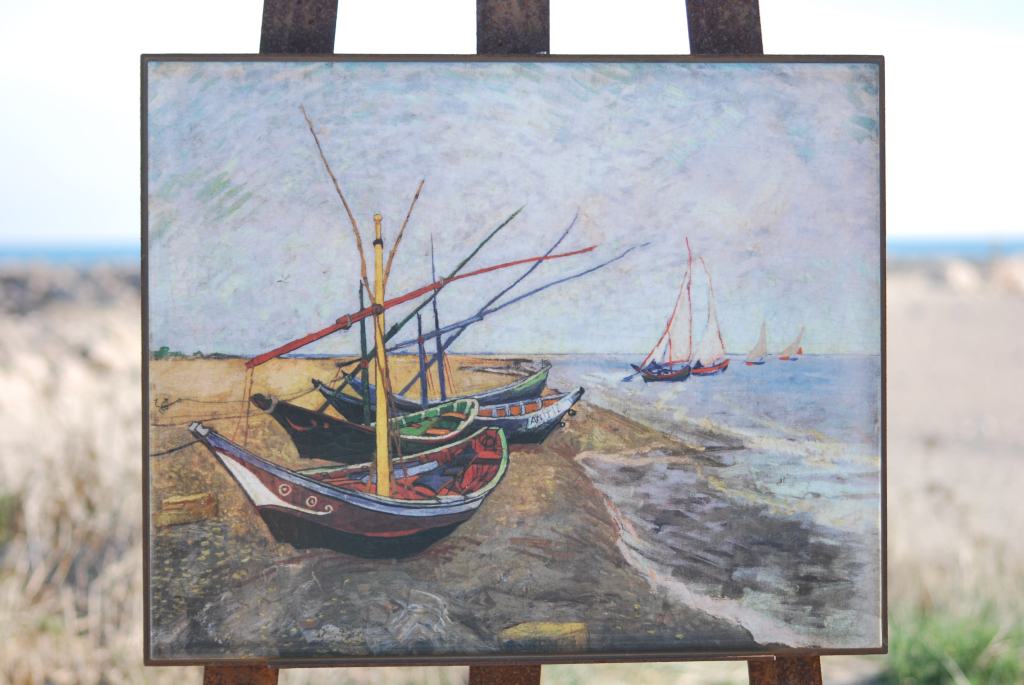
As we wander from reproduction to reproduction we’re struck by the differences between the paintings and today’s beachfront. The thatched, round-gabled fishing cottages are now restaurants, instead of dunes in front of them there’s a carpark. Sea barques pulled up on a wild beach are now replaced by the concrete promenade.

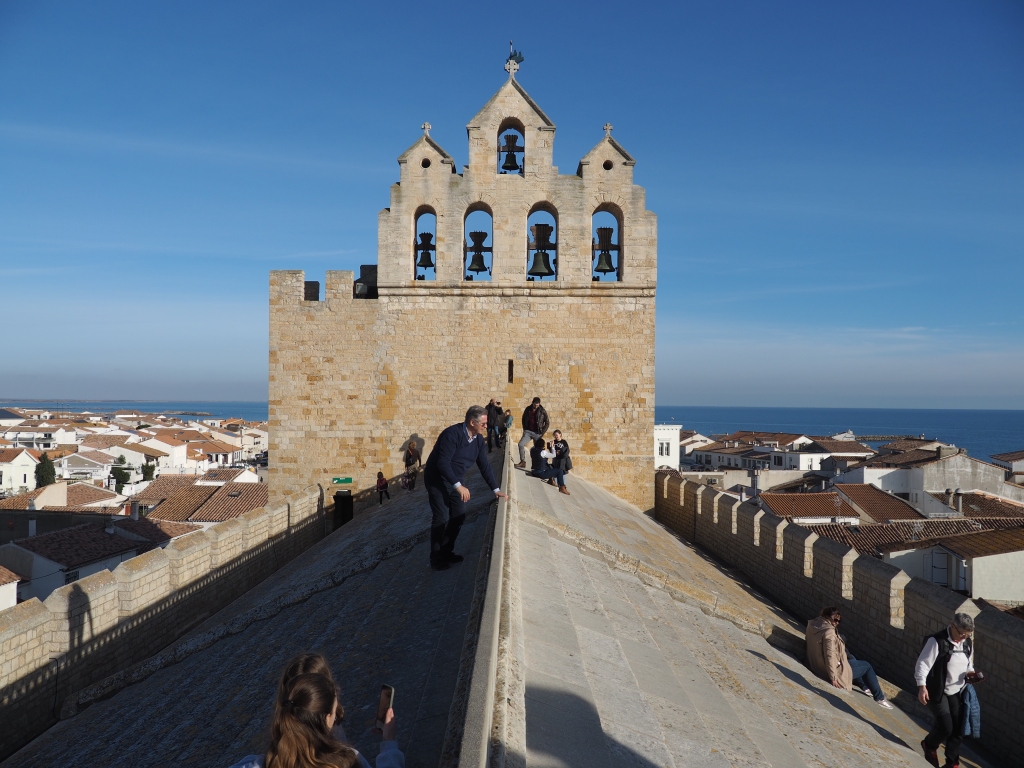
We can’t visit the town without a visit to the Sanctuaire des Saintes-Marie-de-la-Mer. This fortified church was once on the windswept far reaches of the Camargue, it is believed on the spot where the holy women, Saints Marie Salomé and Marie Jacobé rest with Saint Sara, their servant and the patron saint of the Roma and Travelling people who come here to honour her.
Whatever your personal beliefs, there’s something very moving about the photographs and plaques thanking Sara for prayers answered. The crypt has a benevolent feeling to it because of the faith that has been placed in its holy women, because of the candles that are lit here, because of the prayers for loved ones.

Climbing the tower to the sturdy stone roof is a must. You can climb up the roof and sit on the ridge of the church, the sea glittering below, the marsh stretching out beyond the pantiles – everything shouts ‘Camargue’. Of course, I can’t resist walking round the edge of the battlements, to take a peek into hidden patios, with their geometric patterned tiles, their vines shading tables, their limestone walls, the planters waiting for summer geraniums to bloom.


Leave a Reply